Brake Caliper Buyer's Guide
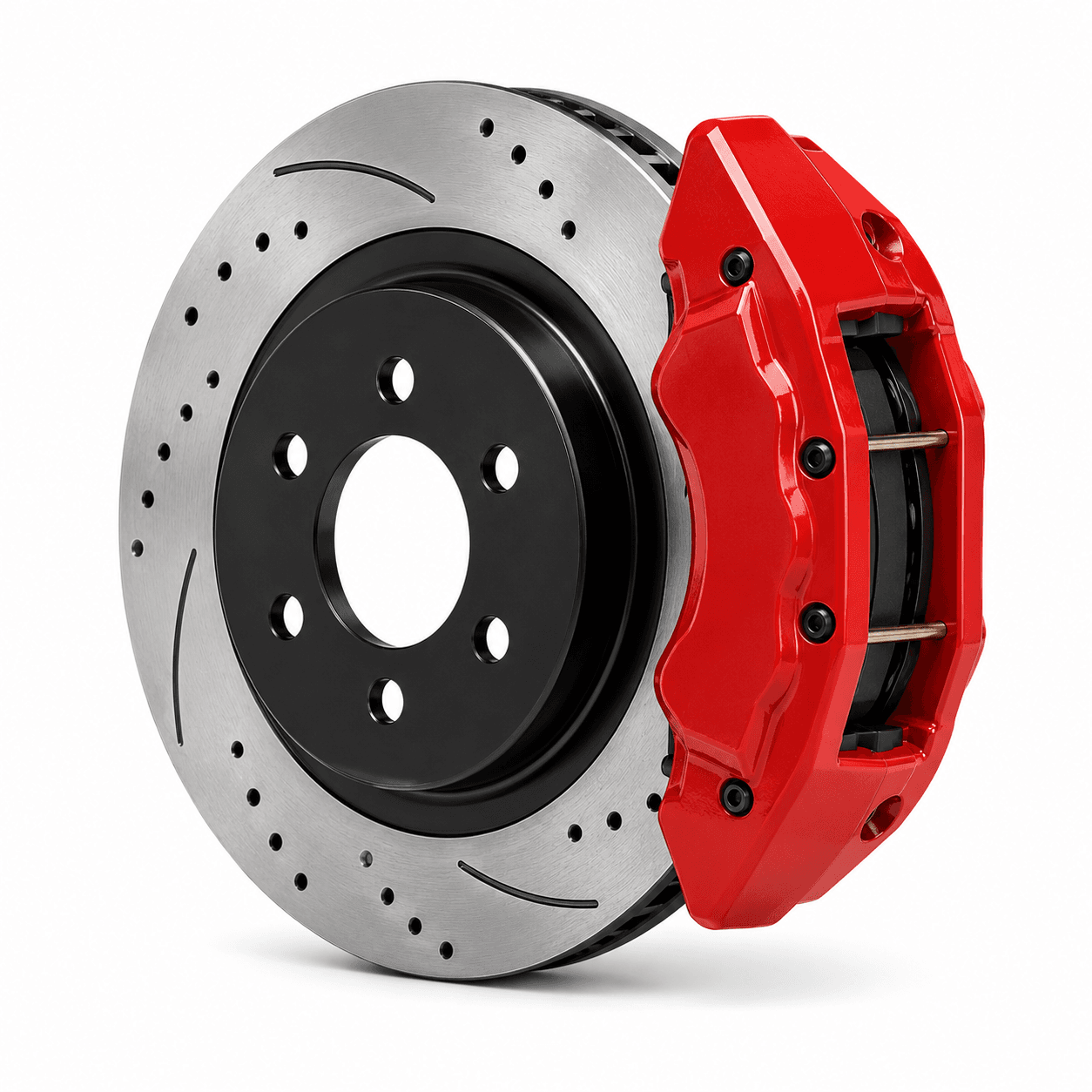
The brake caliper is the component that converts hydraulic pressure into braking force at the wheel. When supplied with pressurized brake fluid, the caliper responds by pressing its pistons outward, squeezing the brake pads against the rotor and creating the friction that slows the vehicle. This guide is complementary to the brake rotor guide which can be found here. This guide covers how calipers work, what specifications matter, common misconceptions, and what to verify before purchasing.
How Brake Calipers Work
Inside every caliper are one or more pistons driven by hydraulic pressure. The amount of clamping force that a brake caliper generates depends on the brake fluid pressure, the number of pistons, and the size of each piston.
There are two fundamental caliper designs:

Floating Calipers have pistons on one side only. When the pistons extend, the caliper body slides on the guide pins to press the opposite pad against the rotor. Floating calipers are the standard design on most passenger vehicles because they are compact, cost-effective, and perfectly adequate for street use. Their sliding mechanism, however, introduces flex under hard braking which can reduce braking precision.
Fixed Calipers are rigidly mounted and have pistons on both sides of the rotor. When actuated, the caliper does not move which offers a significantly stiffer design. This results in a firmer, more responsive pedal feel and better braking consistency. Fixed calipers are the standard choice for performance and track applications.
Bigger Brakes Does NOT Equal Shorter Stopping Distances
One of the most common misconceptions is that bigger brakes mean shorter stopping distances. While larger brakes do provide more clamping force, once the wheels are fully locked, the additional clamping force does nothing. All modern vehicles have more than enough braking force to lock the wheels, so the limiting factor behind stopping distances is often your tire, not the caliper.
Upgrading to a big brake kit, however, does improve your resistance to brake fade. Brake fade occurs when the braking system generates more heat than it can dissipate, something seen during high performance driving. As rotor and pad temperatures climb beyond their operating limits, friction output drops and with it, braking performance. The result is a pedal that feels normal but produces less stopping force than expected, which is both dangerous and unpredictable.
If your goal is shorter stopping distances, start with brake pads, tires, and checking your lines for air or leaks. If your goal is consistent, fade-free performance under sustained hard use, a big brake kit is the right upgrade.
Brake Bias: Front vs. Rear
Not all four calipers share the work equally. Front brakes are usually much larger than rear brakes because they are responsible for approximately 70-80% of the braking force on most vehicles. This is due to weight transfer. When cars brake, their weight shifts to the front. With more weight on the front tires, they are more responsible for grip and therefore braking.
Brake bias is the distribution of braking force between the front and the rear wheels. The goal in any vehicle is for the front wheels to lock up first before the rear wheels. This keeps the vehicle traveling straight. If the rear wheels lock up first, the car becomes uncontrollable and starts spinning. Modern cars use ABS, or some variant of it, to ensure this, but proportioning valves can also be used. Read more about proportioning valves here.
Key Specifications
Caliper Type
As covered above, floating calipers are common on factory vehicles. Fixed calipers offer improved braking response and are the standard choice for performance applications.
Piston Count and Size
More pistons allow the caliper to apply force across a larger area, improving clamping force and pad contact. Multiple pistons also enable the use of larger brake pads, which increases the friction surface area and improves heat distribution. In general, the more pistons, the higher performance the caliper.
Similarly, increasing the size of the pistons increases clamping force and can improve braking performance. However, changing either the piston size or the piston count can affect the balance of the hydraulic system. If you are upgrading calipers on a vehicle with ABS, it is important to maintain the correct front-to-rear piston area ratio to preserve proper brake bias and ABS function. Consult the caliper manufacturer's specifications for your application.
Some performance fixed calipers use pistons of different sizes — smaller at the leading edge, larger at the trailing edge. These are called staggered pistons and they help ensure even pad contact and wear across the pad surface.
Size and Fitment
Caliper size is constrained by the space inside your wheel. Before purchasing, verify:
-
Wheel Inner Diameter Clearance: The rotor and caliper assembly must clear the inner barrel of the wheel. Most aftermarket brake manufacturers publish minimum wheel diameters for a given big brake kit.
-
Spoke Clearance: The caliper must also not contact the wheel spokes. A minimum of 3mm clearance is recommended. Manufacturers publish caliper templates that you can print and physically hold inside your wheel to check this. If your brake kit contacts your spokes, you can use a wheel spacer to correct this. See our wheel spacer guide here.
-
Rotor compatibility: The caliper must be matched to the correct rotor diameter and thickness. Big brake kits typically include a matched rotor and caliper. If sourcing separately, confirm compatibility before purchasing.
Conclusion
For daily driving and mild street use, a quality floating caliper is all you need. For performance applications, particularly those involving repeated hard braking, increased engine power, or track use, a fixed caliper with more pistons and a larger rotor delivers better pedal feel, more consistent performance, and greater fade resistance. Before purchasing, confirm wheel clearance and rotor compatibility. You can find all the parts you need and plan your build on RideBuilder.