Exhaust Manifold & Headers Buyer's Guide
The exhaust manifold is the first component in your exhaust system. It bolts directly to the engine's cylinder head and collects exhaust gases from each cylinder, funneling them into the rest of the exhaust system. Factory manifolds are designed for compact packaging and low manufacturing cost, while aftermarket headers optimize gas flow, reduce backpressure, and improve power. This guide covers how headers work, the key design variables, and what to look for when upgrading.
Exhaust Manifolds vs. Headers
These terms are often used interchangeably but refer to different designs with meaningfully different performance characteristics.
Exhaust Manifolds are the factory units found on most production vehicles. They are typically cast iron, compact, and designed to fit in the tight engine bay at low manufacturing cost. The internal runners are often unequal in length, causing exhaust pulses from different cylinders to interfere with each other and create turbulence and backpressure.
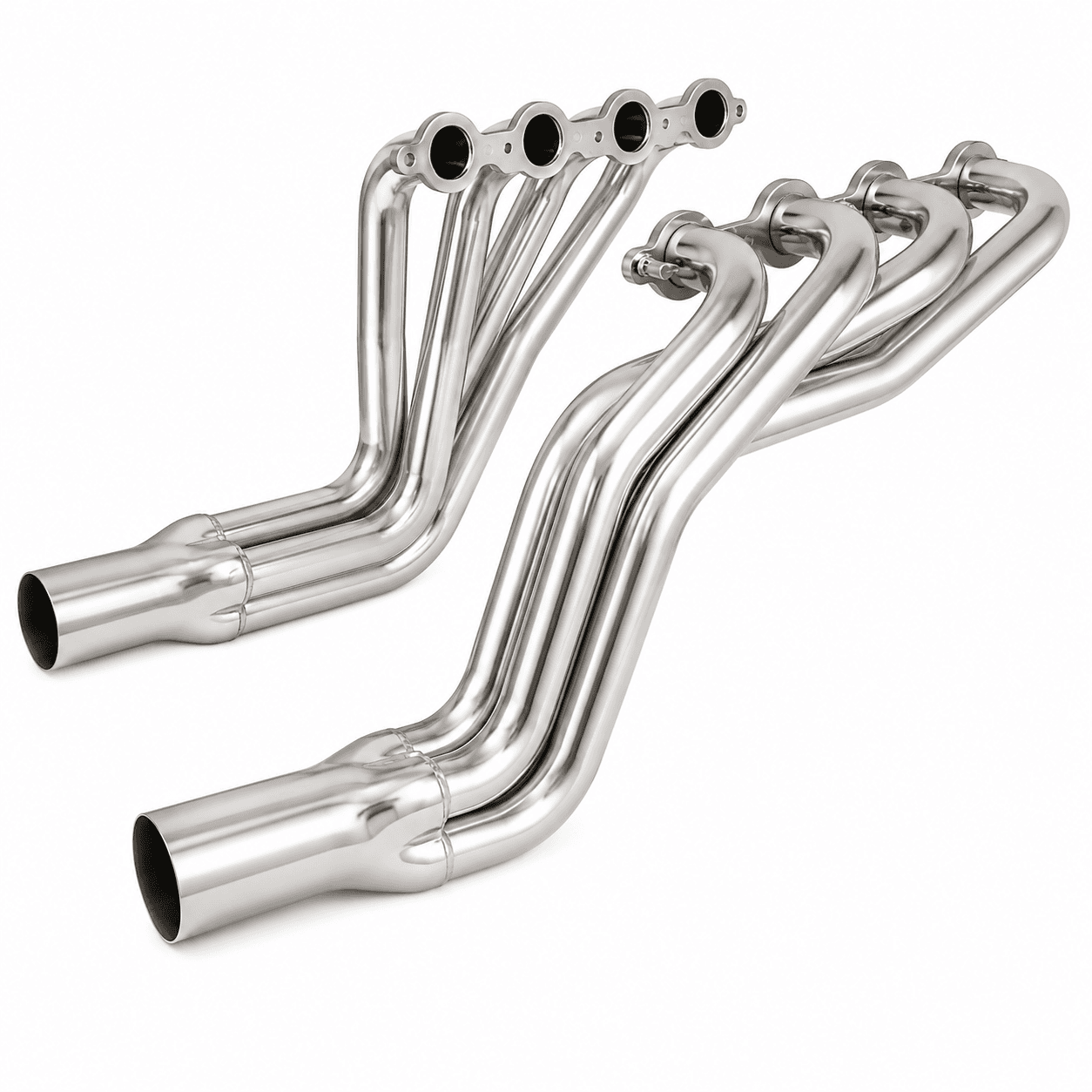
Headers are the performance alternative. Rather than a single cast piece, headers are made from individual tubular stainless steel runners, carefully shaped and merged together to maximize exhaust flow, promote scavenging, and improve power.
Naturally Aspirated vs. Turbocharged Engines
The engine's method of aspiration determines how the manifold is designed and what it does.
-
Naturally Aspirated Engines: Headers connect the cylinder head directly to the catalytic converter. Because naturally aspirated engines rely entirely on atmospheric pressure to draw air into the cylinders, they are highly sensitive to exhaust efficiency. Optimizing this path with high-quality headers is one of the most effective ways to recover lost power on a naturally aspirated platform.
-
Turbocharged Engines: On turbocharged vehicles, the manifold is called a turbo manifold. Instead of routing gas down the exhaust path, it channels exhaust pulses directly into the turbine housing to drive the turbocharger. Turbo manifolds can also include a mounting location for an external wastegate to control boost pressure. For more information on how turbocharged systems work, read our Turbocharger Buyer's Guide.
How Scavenging Works
The primary performance advantage of headers over a stock manifold comes down to scavenging. When an exhaust valve opens, a high-pressure pulse travels down the header tube. When this pulse reaches the collector or encounters a change in pipe volume, a negative pressure wave reflects back toward the cylinder head. If the tube length is tuned correctly, this negative wave arrives at the cylinder during the valve overlap period, helping evacuate residual exhaust gases and pull a fresh intake charge into the cylinder.
Scavenging only occurs over a relatively narrow RPM band, determined by primary tube length:
-
Long tube headers produce scavenging at lower RPM, improving low-to-mid range power.
-
Shorty headers produce scavenging at higher RPM, improving mid-to-high range power.
Scavenging is most impactful on naturally aspirated engines, which can only draw air up to atmospheric pressure. On turbocharged engines, the boost pressure helps fill the cylinder with fresh air, making scavenging a secondary consideration.
Header Styles: 4-1 vs. Tri-Y
The way the primary tubes merge into the collector has a meaningful effect on where in the RPM range power is made.
-
4-1 Headers merge all four primary tubes directly into a single collector. This maximizes scavenging at high RPM and supports peak power output, at the cost of some low-end torque. The right choice for builds chasing peak power.
-
Tri-Y (4-2-1) Headers merge the four primary tubes into two pairs first, then combine those pairs into a single collector. Tri-Y designs create two scavenging events and improve low-mid range torque, but offer slightly less peak power. Tri-Y headers are a great choice for street cars where usable power is more important than peak power.
Equal Length vs. Unequal Length
-
Equal Length: Every primary tube is engineered to be the exact same physical length, so exhaust pulses arrive at the collector at consistent intervals. This prevents pulse interference, maximizes flow, minimizes backpressure, and produces a smoother, more consistent exhaust note. The superior design for peak power, and the standard choice for high-horsepower and track builds.
-
Unequal Length: Runners vary in length, causing exhaust pulses to interfere with one another. This slightly reduces peak flow and introduces mild backpressure, but produces a distinctive rumble. This is famously associated with Subaru's boxer engine. Some enthusiasts specifically choose unequal-length headers for this sound, even at a small cost to top-end power.
It's worth noting that for many builds, the real-world power difference between equal and unequal length is modest. Tube diameter and bend quality often matter more than equal length vs unequal length.
Primary Tube Diameter
Tube diameter controls the balance between flow capacity and exhaust gas velocity.
-
Larger diameter increases flow capacity and reduces high-RPM backpressure, but lowers exhaust gas velocity. On turbocharged engines, oversized runners can increase turbo lag because slower-moving exhaust gases take longer to drive the turbine wheel.
-
Smaller Diameter restricts peak flow but maintains high exhaust gas velocity. High velocity sharpens throttle response on NA cars and promotes quicker turbo spool-up times on forced induction engines.
There's no universal "best" diameter, it depends on your engine's displacement, power level, and target RPM range. The diameters offered for your specific platform are a good guide to what works. Match your selection to your build rather than simply going as large as possible.
Header Material
-
Cast Iron: Standard on OEM manifolds, able to tolerate up to ~700°C continuously. While cast iron exhaust manifolds can handle temperatures higher than this, continuous operation at or above this maximum increases the risk of cracking and failure.
-
409 Stainless Steel: Excellent, budget-friendly material. However, 409 stainless steel will form surface rust over time.
-
304 Stainless Steel: The most common header material in the aftermarket. Ability to tolerate temperatures up to ~870°C continuously. Great choice for most builds.
-
321 Stainless Steel: Able to tolerate even higher temperatures than 304 stainless steel, making it a great choice for high boost turbo builds or racing applications.
-
Mild Steel: Affordable, but will rust through. Not typically recommended.
-
Titanium: Titanium provides significant weight savings and an iconic, rainbow-like appearance on the metal as it is exposed to heat. In addition to their high cost, titanium headers are not typically recommended due to increased risk of cracking under repeated thermal cycling.
Fitment & Emissions Compliance
Engine Bay Clearance: Performance headers, especially long tubes or complex equal-length turbo manifolds, occupy significantly more physical space than stock cast units. Inspect your engine bay carefully before purchasing, as you may need to relocate lines or components to clear the new header.
Emissions Compliance: Factory manifolds often integrate catalytic converters directly into the assembly for rapid warm-up. Long tube headers typically delete or relocate these converters. If your state requires emissions inspections, select CARB-compliant options or shorty headers that preserve the factory emissions hardware.
Conclusion
Upgrading to a quality set of headers is one of the most effective ways to reduce exhaust restriction and increase performance, particularly on naturally aspirated builds where scavenging matters most. Match your header style and tube geometry to your intended RPM range, choose a material appropriate for your heat and power level, and verify engine bay clearance and emissions compliance before purchasing. You can find all the parts you need and plan your build on RideBuilder.