Exhaust Systems Buyer's Guide
Upgrading your exhaust is one of the most popular aftermarket modifications, and for good reason. The right exhaust system can improve performance, transform your vehicle's sound, and enhance its appearance. This guide breaks down the different components within an exhaust system, the upgrade options available, and how to choose the right one for your build.
Why Upgrade Your Exhaust
Factory exhaust systems are mass-produced with an emphasis on emissions compliance and noise suppression, which often creates restrictive backpressure that limits your engine's performance. An aftermarket system removes these bottlenecks, allowing the engine to breathe more freely and produce more power. It also can improve your exhaust note and improve the look of the rear of your vehicle.
Before You Shop: Define Your Goals
The right system depends on what you're trying to achieve. Most builds prioritize one of the following:
-
Performance: If power and throttle response are the priority, focus on reducing restrictions throughout the exhaust system. Smooth mandrel-bent piping, larger diameters, and high-flow components like headers and a downpipe deliver the biggest gains.
-
Sound: For many enthusiasts, sound is one of the primary motivators to upgrade an exhaust. The muffler and resonator are the components that shape your tone, drone, and overall volume, whether you're after a deep rumble or a high-pitched scream.
-
Aesthetics: If you mainly want to enhance the rear profile of your car, exhaust tips make the biggest visual difference. An axle-back system is often the best value if aesthetics are your only concern.
-
Balanced Build: Most street enthusiasts land somewhere in the middle, looking for a crisp exhaust note and a modest power bump without attracting unwanted attention. For these builds, a quality cat-back system is usually the sweet spot.
Expect to budget at least $500 to $1,000 for any significant upgrade. Most enthusiasts opt for a bolt-on kit designed for their specific vehicle, though you can also mix and match individual components to hit precise performance and sound goals.
Exhaust System Components
Every modern exhaust system shares the same core components. Working from the engine backward:

-
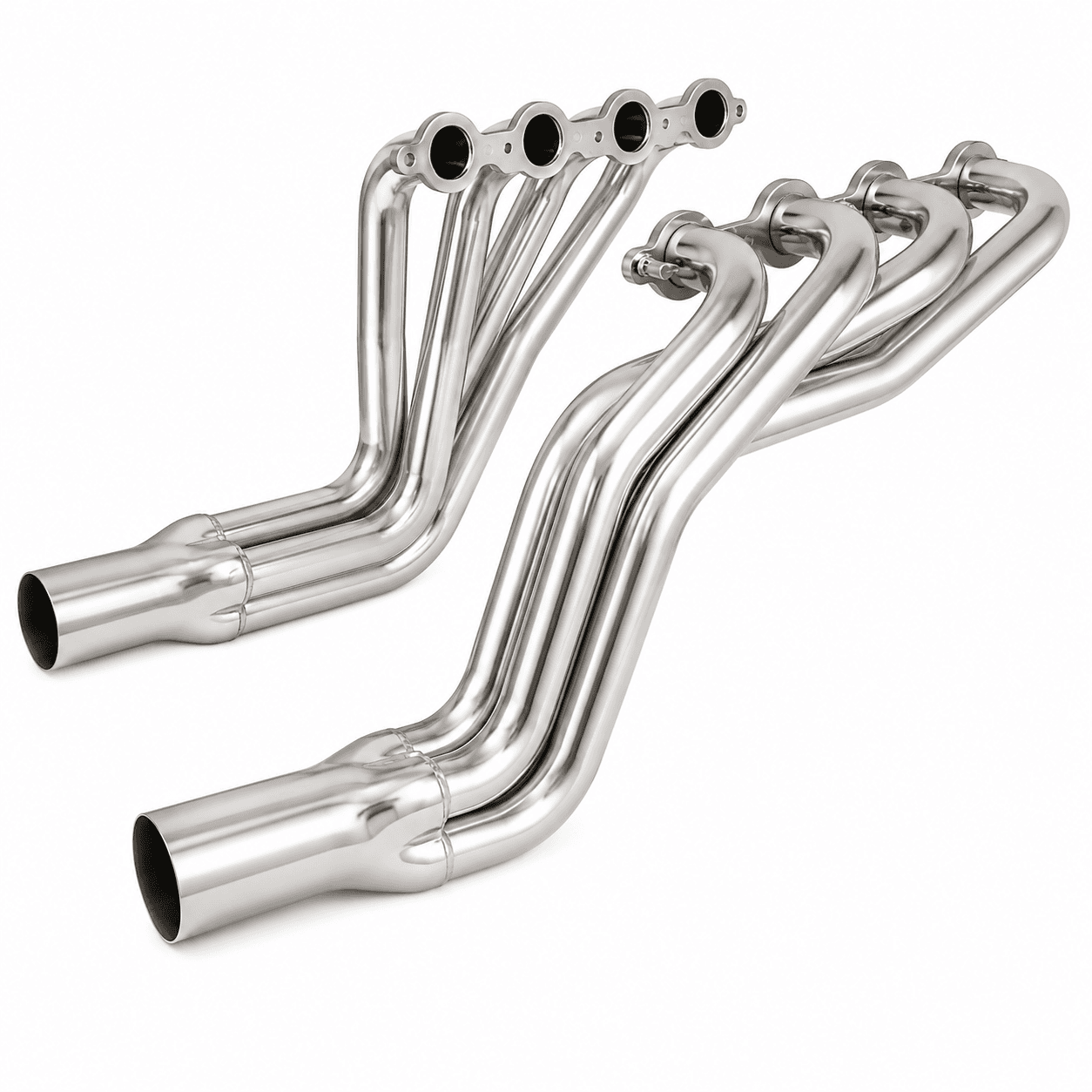
Exhaust Manifold (Headers): Bolts directly to the cylinder head and collects exhaust gases from each cylinder into a single outlet. On turbocharged engines, the manifold also serves as the mounting point for the turbocharger. Engines with two banks, such as V or flat configurations, will have two exhaust manifolds.
-
Downpipe: Present only on turbocharged vehicles. Routes exhaust gases from the outlet of your turbo to the rest of your exhaust system. The downpipe typically contains a catalytic converter and has a significant impact on turbo spool and power.
-
Flex Pipe: A short flexible section of tubing that allows for movement. This prevents the rigid exhaust pipes from cracking or breaking as the engine and exhaust system move during vehicle operation. Most commonly found between the exhaust manifold and the catalytic converter, or integrated into the downpipe on turbocharged vehicles.
-
Catalytic Converter: Converts harmful emissions into carbon dioxide, water, and nitrogen gas using precious metals. Read more about emissions compliance in our catalytic converter buyer's guide.
-
Resonator: Cancels out specific frequencies produced by your exhaust system to eliminate drone during highway cruising.
-
Muffler: Reduces exhaust volume and is the primary determinant of your exhaust's overall character.
-
Tail Pipe/Exhaust Tip: The visible end of the exhaust system where exhaust gases exit to the atmosphere. Primarily aesthetic.
Exhaust System Types
When shopping for an exhaust system, the type determines which components are included and how much of the factory system you are replacing.

-
Header-Back: Replaces everything from the exhaust manifold to the tailpipe. This is the most comprehensive exhaust upgrade available. Delivers the greatest performance gains by addressing every restriction in the system, but comes at the highest cost and installation complexity.
-
Turbo-Back: Specific to turbocharged vehicles. Replaces everything from the turbocharger outlet, including the downpipe, back to the tailpipe. Turbo-back systems are particularly effective because downpipe backpressure directly impacts turbo spool up and flow capacity.
-
Cat-Back: Replaces everything downstream of the catalytic converter including the midpipe, resonator, muffler, and exhaust tips. The most popular upgrade because it delivers meaningful sound and performance improvements at a reasonable price while retaining the factory catalytic converter for emissions compliance.
-
Axle-back: Replaces only the components behind the rear axle including your muffler and exhaust tips. An excellent budget friendly option that improves the sound and looks of your vehicle. Performance gains are minimal since the more restrictive upstream components remain stock. A great entry point for enthusiasts primarily focused on sound and appearance.
Key Specifications
When buying a kit or selecting raw piping, look for these three specifications:
Piping Diameter
Piping diameter is the single biggest factor affecting exhaust flow, but bigger isn't always better. The goal is to match the diameter to your engine's output, then keep it consistent through each section of the system.
-
Too small: Restricts flow and creates a bottleneck that chokes performance, particularly at high RPM where the engine is moving the most exhaust gas.
-
Too large: Reduces exhaust gas velocity, which hurts your exhaust's ability to scavenge. In extreme cases, it can even hurt low-end torque and throttle response.
In general, small 4-cylinders typically run best on 2.25" to 2.5" piping. Turbocharged 4-cylinders and performance V8s usually thrive on 3.0" to 3.5" piping. The ideal diameter depends on your specific power level and goals, so confirm against recommendations for your platform.
Mandrel Bends vs. Crush Bends
Another key factor affecting flow is how the tubing is bent. Budget systems use crush bending, which wrinkles and collapses the pipe at corners, effectively choking a 2.5" pipe down to a 2.0" restriction through the bends. Quality systems use mandrel bending, which keeps a uniform, smooth diameter through every curve. This improves exhaust gas flow and performance, making it the preferred option.
Material
Material affects how long the system lasts, how much weight you save, and even the character of the exhaust note.
-
Aluminized Steel: This is mild steel coated in a thin aluminum-silicon alloy. It is budget-friendly and lightweight, but the protective coating eventually degrades from heat cycles and road debris. If you live in an environment with heavy rain, snow, or winter road salt, an aluminized system can completely rust through in just a few seasons.
-
409 Stainless Steel: The standard material for most factory exhausts and mid-tier budget aftermarket kits. While it is strong and won't easily rust all the way through, it will develop a dull, brownish-red surface oxidation over time.
-
304 Stainless Steel: The gold standard for aftermarket exhausts. It features high levels of chromium and nickel, making it incredibly resistant to rust and environmental corrosion. Develops a beautiful gold, blue, or purple tint when exposed to extreme heat.
-
Titanium: The ultimate choice for high-end or track-focused builds. Titanium is roughly 40% to 50% lighter than stainless steel, allowing you to drop significant weight. Because titanium can be made with incredibly thin wall dimensions, it gives the exhaust note an unmistakably crisp, exotic, metallic "resonance" at high RPMs. However, it is expensive, requires specialized fabrication skills, and is prone to cracking under repeated thermal cycling.
Emissions Compliance
In the U.S., every street-driven vehicle must have a functioning catalytic converter under the Clean Air Act. California and other CARB-compliant states apply stricter standards. In these states, any replacement converter must carry a CARB Executive Order (EO) number to be legal for street use. Emissions regulations vary by location so always check your local laws before modifying your catalytic converter.
Because cat-back and axle-back systems leave the catalytic converter in place, these systems avoid emissions compliance concerns.
Conclusion
Choosing the right exhaust comes down to matching your build to your goals, not just making your car louder. Start by deciding what matters most: performance, sound, aesthetics, or daily drivability. From there, the system type points you in the right direction. For most enthusiasts, a quality vehicle-specific cat-back or axle-back system hits the sweet spot of fitment, sound, reliability, and simplicity, with no emissions headaches. If you're chasing maximum power, a header-back or turbo-back system unlocks the most, though it demands a bigger budget and a closer eye on emissions compliance.
Whichever route you take, prioritize mandrel-bent piping in an appropriate diameter, choose a material suited to your climate, and confirm your setup is legal for your state before buying. Get those fundamentals right and you'll have an exhaust that improves how your car looks, sounds, and performs. You can find all the parts you need and plan your build on RideBuilder.